




Each year, influenza and COVID-19 infections cause thousands of deaths and hundreds of thousands of severe infections, and even milder infections can cause significant discomfort, resulting in missed work and school.
Vaccines offer a first-line protection, but no vaccine is 100-percent effective, and infections can still occur.
The nasal spray may turn out not to be foolproof either — no approach is — but it could augment current preventive measures.
“We need new, additional ways to protect ourselves and reduce the transmission of the disease,” Karp said.
A gel-like, drug-free nasal shield
The nose is a favored gateway into the body for many viruses and bacteria. Most respiratory infections, such as flu and COVID, occur after someone breathes in tiny droplets of fluid that contain the pathogen. Once inside the nose, the viral or bacterial particles inside the droplets infect the cells that line the nasal cavity. The pathogen replicates and travels further down the respiratory tract of the infected individual, sometimes reaching the lungs, where it can cause bronchitis and pneumonia. The pathogen can also be released back into the air when an infected person, whether they know it or not, sneezes, coughs, laughs, sings, or even just breathes in and out.
Current nasal sprays offer limited protection against respiratory pathogens because they have a single mechanism of protection. They either neutralize pathogens or block their entry into the cells lining the nose, and they perform both tasks with limited efficacy.
“We developed a drug-free formulation to block germs in three ways — the spray forms a gel-like matrix that enhances the capture of respiratory droplets, immobilizes the germs blocking their transport into the nasal lining, and effectively neutralizes them, preventing infection,” said co-senior author Nitin Joshi, HMS assistant professor of anaesthesia at Brigham and Women’s Hospital.
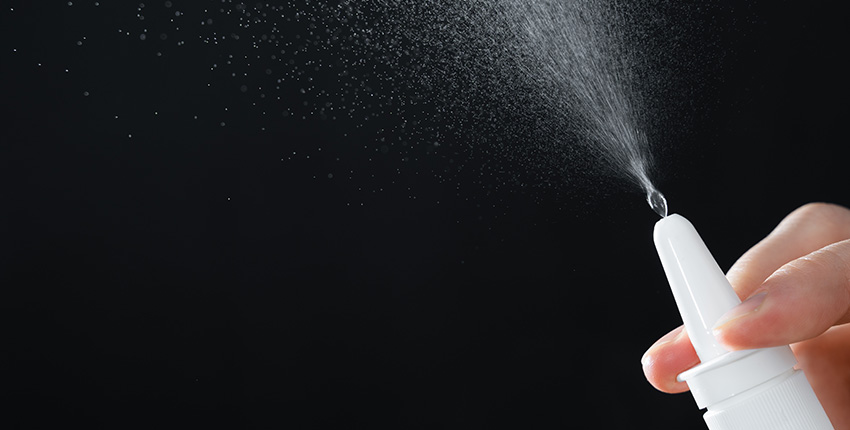
The nasal spray, called Pathogen Capture and Neutralizing Spray (PCANS), was developed with nonpharmaceutical ingredients already used in approved nasal sprays or listed in the FDA’s Generally Recognized as Safe (GRAS) list.
The researchers designed the formulation and studied its ability to capture respiratory droplets in a 3D-printed replica of the human nasal passages. The experiments showed that when administered into the nasal cavity model, the spray captured twice as many droplets as naturally occurring mucus, produced as part of the body’s innate defense system.
“PCANS forms a gel, increasing its mechanical strength by a hundred times, forming a solid barrier,” said study first author John Joseph, a former postdoctoral fellow at Brigham and Women’s Hospital.
In the 3D model of the human nasal passage, the spray blocked and neutralized nearly 100 percent of all viruses and bacteria tested, including influenza, SARS-CoV-2, RSV, adenovirus, and Klebsiella pneumonia, the experiments showed.
Next, the researchers tested the spray’s protective effects against a strain of influenza in mice. The spray was rapidly activated following administration into the nose and lasted up to eight hours. A single dose could effectively block infection from an influenza virus at 25 times the lethal dose of the virus. This means that the spray was capable of warding off infection even when animals were exposed to a heavy load of the virus. Notably, virus levels in the lungs of pretreated animals were reduced by nearly 100 percent, compared with nontreated animals. The levels of various immune and inflammatory cells in the lungs of treated animals also remained normal.
“The formulation’s ability to inactivate a broad spectrum of pathogens, including the deadly PR8 influenza virus, demonstrates its high effectiveness,” said co-senior author Yohannes Tesfaigzi, AstraZeneca Professor of Medicine in the Field of Respiratory and Inflammatory Diseases at Brigham and Women’s Hospital and HMS. “In a rigorous mouse study, prophylactic treatment with PCANS demonstrated exceptional efficacy, with treated mice exhibiting complete protection, while the untreated group showed no such benefit.”
Adapted from a Brigham and Women’s press release.
link
More Stories
Tips for sleeping with a stuffy nose
Comparison of physician and large language model chatbot responses to online ear, nose, and throat inquiries
Is That “Quick Relief” Nasal Stick Harming Your Teen’s Nose?